
The U.S. Environmental Protection Agency notes that people spend approximately 90% of their time indoors, making indoor environments important spaces for studying movement, comfort, and environmental conditions. As technology for building analysis becomes more accessible, researchers and property managers increasingly use heat mapping tools to understand how people move through apartments and shared residential spaces.
Environmental analysis often includes information from multiple sources used in residential planning discussions, including topics linked to professional bed bug removal in NYC when evaluating movement patterns, furniture placement, or occupancy behavior. These references usually appear as part of broader conversations involving maintenance planning and indoor environmental management rather than isolated concerns.
Apartment heat maps are visual tools that display areas of high and low activity within a building or unit. While they are commonly associated with retail environments, workplace planning, and website analytics, indoor environmental specialists increasingly recognize their value in residential settings. Heat maps can reveal where people frequently gather, how often spaces are used, and where traffic patterns repeatedly form.
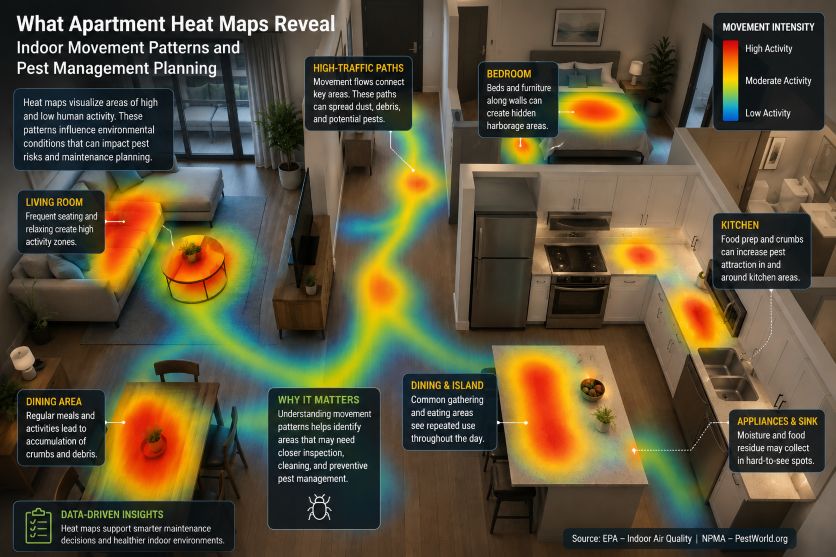
Expected Patterns Versus Observed Reality
People often assume apartment movement follows predictable routines. A typical expectation might suggest residents move from bedrooms to kitchens, then toward living areas in consistent paths throughout the day. Floor plans themselves often imply these patterns through hallway placement, furniture arrangement, and room design.
Actual movement data frequently tells a more complex story.
Research published by MIT Senseable City Lab and studies in indoor behavioral analysis suggest that occupants adapt spaces based on convenience, habit, and environmental comfort. People may create informal pathways that differ from architectural expectations. A chair positioned near a window may become a daily workspace. Entryways may transform into storage areas. Corners originally designed as decorative spaces can become regular activity zones.
Observed movement patterns sometimes concentrate around surprisingly small areas. A charging station near a wall outlet may attract repeated visits. Shared kitchen counters can become central gathering points. Areas around couches or work desks may experience more sustained activity than designers originally intended.
These differences matter because movement creates environmental effects that are often invisible during ordinary daily routines.
How Environmental Conditions Develop Around Activity Zones
Repeated movement changes indoor environments in subtle ways. Human activity influences temperature distribution, airflow patterns, humidity levels, and the movement of particles throughout a space.
The Centers for Disease Control and Prevention explains that indoor environments continuously change due to human presence and building characteristics. Increased activity can affect heat generation and alter air circulation patterns.
Examples include:
- Foot traffic moving dust and particles through hallways
- Heat accumulation around occupied spaces
- Humidity increases in kitchens and bathrooms
- Furniture placement affecting airflow movement
- Storage areas creating reduced circulation zones
Many of these conditions appear minor when viewed individually. Over time, however, repeated patterns can create environments that differ significantly from initial expectations.
Heat maps provide a visual comparison between design assumptions and lived behavior.
Where Movement Analysis Connects With Pest Management Planning
Pest management planning increasingly relies on understanding environmental conditions rather than focusing only on visible activity. Building experts often examine patterns that reveal where conditions supporting pest activity may unintentionally develop.
The National Pest Management Association notes that pest issues frequently involve environmental factors such as access to food, shelter, moisture, and movement pathways.
Movement patterns may indirectly affect these factors.
For example, repeated traffic through kitchens can increase the presence of food particles in surrounding areas. Storage spaces that receive little attention might accumulate clutter over time. Furniture arranged against walls may reduce visibility and airflow around specific locations.
Comparing expected movement with observed activity sometimes identifies overlooked conditions:
- Underused corners collecting dust and debris
- High-traffic pathways distributing particles through rooms
- Shared residential areas experiencing heavier environmental stress
- Storage zones receiving limited cleaning attention
- Furniture arrangements creating concealed spaces
This does not suggest movement itself creates problems. Instead, movement patterns help explain how environments evolve through everyday use.
Comparing Traditional Observation With Data-Based Analysis
Traditional apartment assessments often depend on visible inspection and resident reports. Maintenance teams may look for signs of wear, moisture concerns, or structural conditions during scheduled visits.
Heat mapping adds another layer of understanding.
Traditional observation asks:
- What appears visible today?
- Where are current concerns located?
- Which areas require immediate attention?
Environmental mapping asks additional questions:
- Where do people repeatedly gather?
- Which areas experience prolonged activity?
- How does movement change conditions over time?
Data indicates that combining direct observation with environmental analysis provides a more complete understanding of residential spaces. Patterns invisible during a single inspection may become more noticeable when viewed across longer periods.
Overlap With Broader Residential Planning
Heat maps increasingly influence conversations beyond maintenance concerns. Property managers, architects, and environmental specialists use movement information to evaluate building efficiency and resident experiences.
The American Society of Heating, Refrigerating and Air-Conditioning Engineers (ASHRAE) emphasizes that indoor environmental quality depends on multiple interacting factors including ventilation, thermal comfort, occupancy patterns, and building use.
Movement analysis contributes to these discussions because people rarely use spaces exactly as originally intended. Decisions involving layouts, ventilation, furniture arrangement, and even eco-friendly flooring choices in residential spaces can influence how residents interact with their environments. Materials and design elements often affect comfort, maintenance requirements, and how activity patterns develop over time.
A hallway designed primarily for passage may become a temporary storage area. Living rooms may function as offices. Small apartments often require flexible use of limited square footage.
These changes influence maintenance decisions and environmental planning strategies.
Wider Implications for Residential Spaces
Apartment heat maps ultimately reveal a simple reality: buildings may be designed around expectations, but people create their own patterns through daily behavior.
The comparison between expected and observed movement offers useful insight for environmental management and pest planning discussions. Understanding where activity concentrates helps explain how temperature, airflow, clutter accumulation, and other environmental conditions develop over time.
Residential spaces continue changing long after construction ends. Human routines reshape environments every day through movement, habits, and repeated interactions with physical space.
Environmental analysis and broader pest management considerations increasingly recognize that understanding these patterns can provide a more complete picture of how indoor spaces function. Rather than focusing only on isolated observations, long-term movement trends can help support informed planning decisions across residential environments.