
Buildings account for roughly 37% of global energy-related carbon dioxide emissions, a figure highlighted by UN Environment Programme (UNEP) reports. As cities and homeowners seek ways to improve outdoor comfort while reducing environmental impact, outdoor climate systems such as pergolas, shade structures, adjustable canopies, and weather-responsive installations have become increasingly important. The challenge lies in deciding whether standardized prefabricated systems or fully customized outdoor structures offer the better path toward sustainability.
The debate reflects broader trends in modern construction and environmental design. Research from Pergomaxx and other modular outdoor system providers illustrates how standardized components can be adapted to diverse environments while maintaining manufacturing efficiency. At the same time, architects and landscape designers continue to advocate for custom-built solutions that respond precisely to site-specific conditions. Both approaches offer distinct environmental advantages and limitations, making the comparison increasingly relevant as climate adaptation becomes a priority.
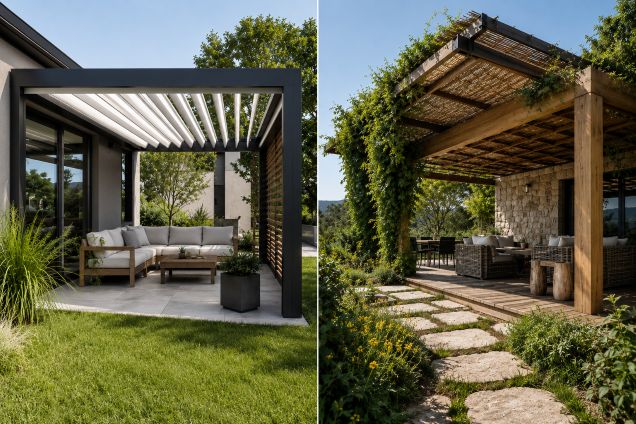
The Case for Standardized Outdoor Climate Systems
Standardized outdoor climate systems are typically manufactured using repeatable components and production methods. These systems often include modular pergolas, adjustable shading structures, retractable roofs, and weather-management installations that can be assembled on-site with minimal customization.
Supporters of standardization argue that consistency creates environmental benefits throughout the supply chain. Manufacturing large quantities of similar components enables producers to optimize material use and reduce waste. Data from the International Energy Agency (IEA) suggests that industrial efficiency improvements can significantly lower resource consumption compared to highly individualized production processes.
Standardized systems also simplify transportation and installation. Components can be designed for efficient packaging, reducing shipping volume and associated emissions. Installation timelines are often shorter, which can reduce equipment use and construction-related disturbances.
Another advantage lies in maintenance and replacement. Because standardized components follow consistent specifications, repairs can often be performed without replacing entire structures. This supports circular economy principles promoted by organizations such as the European Environment Agency (EEA), which encourages extending product lifespans and minimizing waste generation.
The Argument for Custom-Built Solutions
Customization offers a different set of environmental opportunities. Rather than adapting a site to fit a product, custom structures are designed around the unique characteristics of a location.
Landscape architects often emphasize the importance of local conditions. Sun exposure, prevailing winds, rainfall patterns, surrounding vegetation, and building orientation can vary significantly even within the same neighborhood. Custom outdoor climate systems can address these variables with greater precision.
Experts from the American Society of Landscape Architects (ASLA) note that site-responsive design can improve thermal comfort, support biodiversity, and enhance stormwater management. A custom structure may integrate native plantings, rainwater collection systems, or unique shading configurations that standardized products cannot easily accommodate.
Customization can also preserve architectural identity. Historic districts, culturally significant properties, and unconventional building forms often require tailored solutions. In such situations, environmental performance must be balanced with aesthetic and contextual considerations.
However, customization frequently requires additional design work, specialized materials, and unique fabrication processes. These factors can increase resource consumption and generate more construction waste compared to modular alternatives.
Efficiency and Resource Management
The environmental debate often centers on efficiency. Standardized systems generally excel in material optimization because manufacturers can refine production processes over time. Repeated fabrication allows for better forecasting, lower error rates, and reduced scrap material.
Studies published by the World Green Building Council indicate that industrialized construction methods frequently improve resource efficiency when compared with conventional bespoke construction. Similar principles apply to outdoor structures, where modularity can reduce excess material use.
Yet efficiency cannot be measured solely at the manufacturing stage. A custom-designed climate system that maximizes passive cooling or shading performance may deliver long-term energy benefits that offset higher initial resource consumption. For example, a structure carefully positioned to reduce solar heat gain could lower cooling demands for adjacent indoor spaces.
This creates a key tension within the sustainability discussion. Standardization often improves production efficiency, while customization may improve operational performance under certain conditions.
Waste Reduction and Circular Design
Waste reduction represents one of the strongest arguments for modular systems. Standardized components can be reused, repaired, upgraded, or relocated more easily than highly customized structures.
The Ellen MacArthur Foundation, a leading advocate of circular economy principles, highlights modularity as a critical strategy for extending product life cycles. When components are interchangeable, fewer materials enter the waste stream during renovations or upgrades.
For example, if climate conditions change or property needs evolve, modular outdoor systems may allow individual sections to be replaced without dismantling the entire structure. This flexibility can significantly reduce demolition waste.
Custom-built structures face greater challenges in this regard. Unique dimensions and specialized components may be difficult to reuse elsewhere. Once a property changes ownership or purpose, the structure may require extensive modification or complete replacement.
Nevertheless, some custom projects successfully incorporate reclaimed materials, locally sourced resources, and adaptive design strategies. In these cases, customization can support waste reduction through careful planning rather than standardization alone.
Adaptability in a Changing Climate
Climate resilience is becoming an increasingly important consideration for outdoor environments. Rising temperatures, changing precipitation patterns, and more frequent extreme weather events require flexible design approaches.
Standardized modular systems often perform well because they can be upgraded incrementally. Adjustable louvers, retractable coverings, and expandable modules allow users to respond to changing environmental conditions without major reconstruction.
Customization, however, may offer deeper adaptation when local climate challenges are especially complex. Coastal environments, mountainous regions, and urban heat islands often present unique conditions that benefit from site-specific solutions.
The choice therefore depends on scale and context. Standardization provides broad adaptability across many locations, while customization can achieve targeted performance in specialized environments.
Finding a Balanced Path Forward
The comparison between standardized and customized outdoor climate systems should not be viewed as a simple competition with a single winner. Environmental performance depends on how effectively each approach addresses resource use, operational efficiency, waste reduction, and long-term adaptability.
Modern design trends increasingly combine elements of both philosophies. Manufacturers are developing modular platforms that allow meaningful customization without sacrificing production efficiency. Designers, meanwhile, are using standardized components as building blocks within broader site-specific strategies.
This hybrid model may represent the most practical path forward. It preserves the environmental advantages of modular manufacturing while providing sufficient flexibility to respond to local climate conditions and user needs. Beyond efficiency and resource management, outdoor environments also play an important role in personal well-being. Thoughtful design decisions can contribute to healthier and more comfortable living spaces, echoing broader discussions about creating a nurturing environment for yourself through intentional interactions with the spaces we inhabit.
As sustainability goals continue to influence architecture and landscape design, the future of outdoor climate systems will likely depend less on choosing between standardization and customization and more on integrating the strengths of both. The most successful solutions will be those that minimize waste, maximize durability, and remain adaptable throughout their lifecycle, supporting comfortable outdoor spaces while reducing environmental impact.