


How Dust and Allergens Build Up in Places You Don’t See
Dust and allergens often collect in vents, along baseboards, and deep inside soft furnishings where routine cleaning may not reach them. The U.S. Environmental Protection Agency explains that household dust can contain pollen, mold spores, pet dander, dust mites, human skin flakes, and particles carried indoors from outside.
A room can therefore look clean while still holding a surprising amount of hidden debris. Maintaining a tidy household involves paying attention to areas beyond countertops and visible floors. Dust can settle behind furniture, around air vents, beneath beds, along floor edges, and within fabrics. These areas are easy to overlook because they are rarely at eye level.
Why Dust Collects in Hidden Areas
Household dust is constantly moving. Walking, opening doors, changing bedding, vacuuming, and even sitting on furniture can disturb settled particles. The U.S. Environmental Protection Agency notes that normal activities can send settled dust back into the air. Eventually, some of those particles land in quieter areas that receive less cleaning.
Baseboards are a good example. Air movement can carry fine particles toward walls and floor edges. Furniture may then block easy access to these spots. Over time, visible dust may develop behind sofas, cabinets, beds, and other large items.
Heating and cooling systems add another layer. The U.S. Environmental Protection Agency reports that biological contaminants can enter through ventilation systems. Poorly maintained central air systems may also distribute contaminants through different parts of a home.
What Is Actually Hiding in Household Dust?
Dust is more complicated than it appears. It can include particles from soil, cooking, cleaning products, hair, skin, pollen, fabrics, pets, and outdoor pollution. Some of these materials are harmless to most people. Others can become allergy or asthma triggers for sensitive household members.
Three common concerns are dust mites, pet allergens, and mold spores. Each behaves differently, which is why cleaning only visible surfaces may leave some sources untouched.
Dust Mites Prefer Fabrics and Humidity
Dust mites are microscopic creatures that feed largely on tiny flakes of human skin. The Asthma and Allergy Foundation of America explains that these flakes collect inside mattresses, carpets, upholstered furniture, bedding, and stuffed toys. Warm and humid conditions can help mites survive.
The mites themselves are only part of the issue. Their body parts and waste contain substances that can trigger allergic reactions in sensitive people. These materials can remain after the mites die.
The American Lung Association notes that dust mite allergens tend to settle quickly rather than remaining airborne for long periods. This helps explain why mattresses, curtains, carpeting, and upholstered furniture can become important reservoirs.
Pet Allergens Travel Beyond the Pet’s Favorite Spot
Pet-related allergens are also easy to underestimate. They are not limited to visible fur. Animals shed skin cells, and allergenic proteins can also come from saliva and other biological material.
The Asthma and Allergy Foundation of America describes animal allergens as sticky. They can settle on furniture, walls, flooring, bedding, and other surfaces. That means keeping a pet off one chair does not necessarily keep allergens confined to another part of the house.
Pets can also bring outdoor particles inside. Pollen and other material may attach to fur before being carried into living spaces. Regular attention to pet bedding and frequently used furniture can therefore help reduce buildup.
Moisture Changes the Problem
Dust becomes more concerning when excess moisture enters the picture. The Centers for Disease Control and Prevention explains that mold can grow on materials including wood, drywall, carpet, fabric, insulation, and upholstery when enough moisture is available.
Mold spores naturally exist indoors and outdoors. They can enter through doors, windows, vents, heating and cooling systems, clothing, shoes, and pets. A spore that lands on a dry surface may cause no visible problem. When it reaches a persistently damp area, conditions can support mold growth.
This makes hidden leaks especially important. Moisture behind furniture, beneath carpeting, around windows, or near plumbing may go unnoticed. The CDC advises controlling indoor moisture and repairing leaks because removing visible mold without addressing its moisture source does not solve the underlying problem.
Why Cleaning Technique Matters
Removing dust is useful, but the method matters. Dry sweeping and aggressive dusting can disturb fine particles and return some of them to the air. The U.S. Environmental Protection Agency recommends frequent cleaning and suggests using a damp cloth for dusting because it helps capture settled material instead of simply stirring it up. Carpets may need extra attention because particles can settle deep within their fibers. Looking at deeper carpet cleaning methods can also help homeowners understand how vacuuming and more thorough cleaning approaches deal with contaminants that remain in carpeted surfaces.
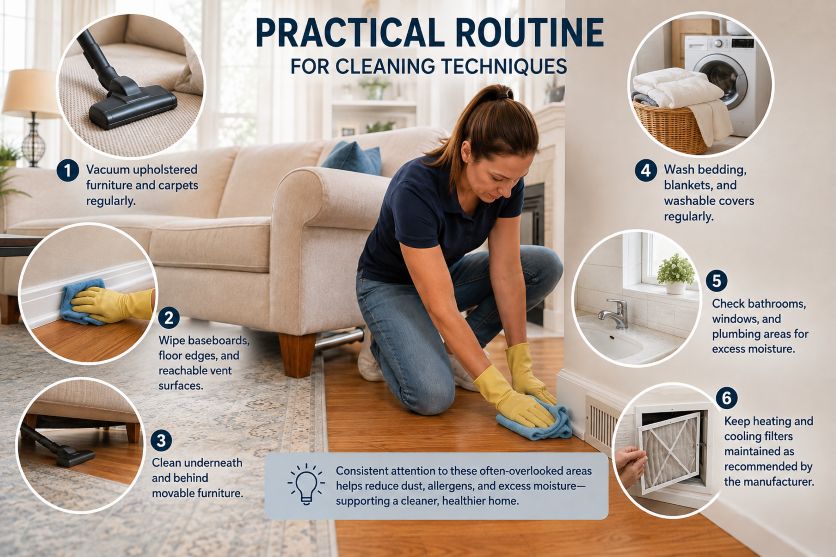
A practical routine can include several overlooked areas:
- Vacuum upholstered furniture and carpets regularly.
- Wipe baseboards, floor edges, and reachable vent surfaces.
- Clean underneath and behind movable furniture.
- Wash bedding, blankets, and washable covers regularly.
- Check bathrooms, windows, and plumbing areas for excess moisture.
- Keep heating and cooling filters maintained as recommended by the manufacturer.
Humidity deserves attention as well. The U.S. Environmental Protection Agency generally recommends indoor relative humidity of about 30 to 50 percent. Lowering excess humidity can make conditions less favorable for dust mites and mold.
A Clean-Looking Room Is Only Part of the Picture
Visible cleanliness gives useful clues about a home’s condition, but it cannot show what has settled inside a sofa, behind a cabinet, or along a rarely disturbed floor edge. Allergens accumulate gradually because homes are active environments. People cook, walk, sleep, open windows, bring items indoors, and share spaces with pets.
A more complete approach focuses on both visible surfaces and the places where particles naturally settle. Regular cleaning, moisture control, washable fabrics, and attention to overlooked areas can reduce buildup over time. The goal does not need to be a perfectly dust-free home. Instead, consistent care can limit the hidden reservoirs that allow common indoor allergens to keep accumulating.



 In Bolivia, The Gran Manupare Integrated Management Natural Area recently added the municipality of Sena as established law aimed to protect 1.1 million acres (452,639 hectares) of Amazon rainforest. The community of Sena is the latest local municipality that represents a piece of the massive conservation mosaic created by indigenous communities and local municipalities that have been interconnected after taking on the cudgel of protecting their forest into their own hands.
 The Pando Department has about 70 percent of forests constituting sustainably managed Brazil nut trees that serve as a main source of livelihood for local communities. The Pando Department’s established conservation area, The Gran Manupare also provides sanctuaries for Bolivia’s huge collection of species including the jaguar and the endangered giant river otter.
 Bolivia has one of the largest
  In addition to the agricultural exploitation, forest fires occurring yearly have contributed to the denudation of the virgin forests in the country.
 Most of us are constantly looking for ways to live greener and reduce our carbon footprint. While many environmental enthusiasts focus on big topics like deforestation or plastic pollution, there’s a lesser-discussed topic that’s just as crucial – appliance repair Vancouver.


 Safety in the workplace should be taken seriously regardless of the kind of business you operate. Whatever the size of your business, whether you have a thousand employees or only ten, it is imperative that you provide a safe environment for all of your workers by creating safety regulations as well as preventive measures to avoid work-related accidents.

 More than 8% of global carbon emissions come from transportation, including moving trucks and vans. This means even a single long-distance relocation can have a big environmental impact. However, with the right planning and eco-conscious choices, you can make your move from Greenwich to Charleston far greener. From biodegradable packing to fuel-efficient transport, green moving practices are no longer just an option—they are a necessity for anyone who wants to reduce their footprint.
 Moreover, the skydiving community usually promotes a strong respect of the surroundings. The breathtaking panoramic views from above can create a strong bond to the earth and its fragility. This natural respect can be directed toward supporting more general environmental concerns such as climate change since a stable and healthy atmosphere is not only important for their sport but also for the welfare of the earth.
 Snow biking is becoming a popular way to explore rugged trails while leaving a smaller environmental footprint. For those unfamiliar, snow biking combines the excitement of motocross with snow sports, using specialized kits that convert dirt bikes into snow-ready machines. As outdoor enthusiasts seek greener ways to adventure, snow biking with Timbersled kits has gained attention for reducing environmental impact.
 Olympics


 Outsourcing has become an increasingly popular option for businesses of all sizes. By hiring external companies or virtual assistants, businesses can save on costs and improve their overall efficiency. But did you know that outsourcing can also have a positive impact on the environment? In this article, we will explore how outsourcing can help your business save money and reduce its environmental footprint.


 Regarding environmental challenges, fashionistas are progressively moving from fast fashion to sustainable fashion brands. Sustainable fashion is no longer just a statement of responsibility but also an expression of fashionable style just like buying some apparel from techwear official. Sustainable fashion was once associated with limited design, but those days are long gone. Today, big brands and prominent designers throughout the world naturally follow this trend. It does, however, take some effort to maintain these sustainable fashion pieces “sustainable,” and here are a few pointers to help you produce them faster and more efficiently.
 Studying esoteric arts and other spiritual areas will make you more aware of yourself and your surroundings. We are all connected, and how you live your life affects the people around you, your community, and the world. Numerology and other spiritual tools can help you
  Although astronomy is not included as a subject in the country’s education system, the Bolivian San Agustin Remote Observatory provides instruments for constellation observations to amateur astronomy clubs and schools.
 Today, believers in astrology benefit from computerized observations collected by observatories. Gathered in by way of narrow band filters, corrective optics, solar telescopes and innovative accessories that help in generating a great compilation of astronomical knowledge and data. Twelve thousand years ago ancient nomadic tribes presumably followed the paths toward the north node in leo. It appears that they had shed their hunter-gatherer way of life as they found it more beneficial to permanently engage in agriculture in South America
